Crown Brush Pattern: Why the Swirl Is the Last Section to Close
The crown is where hair direction changes inside one brush width, so normal strokes skip it or fight it. How to find your whirl, the stroke pattern that lays it down, and where to stop.
There is almost always one section that lags. The front lays down, the sides start to show a pattern, and the top center stays a loose patch that will not follow anything. That patch is your crown, the spot where hair grows out in a spiral instead of lying in one direction.
The usual response is to brush it harder, longer, and firmer. That is the wrong lever. The crown is rarely a firmness problem; it is a direction problem with an angle complication. Find the whirl, change the stroke, lighten the pressure, and set the rag so it stops undoing the work overnight.
What is actually happening at the crown
A crown, sometimes called a whorl, is the point where hair grows outward in a spiral instead of lying flat. Two centimeters off that center the hairs lie the way the rest of your head does. At the center they stand more upright and rotate. In between is a narrow ring where direction is genuinely ambiguous.
Waves are direction plus compression: you train hair to lie one way and hold it there long enough that it starts to stay. That works because most of your scalp gives the same answer to "which way do I lie". The crown does not. A single stroke direction can serve either the center or the ring around it, not both, and a long stroke across the center drags those upright hairs the wrong way.
There is a second factor nobody mentions: the crown is the piece of your head you handle most. You start strokes there, you check it in the mirror all day, you press on it when you think. Handling is disturbance, and no other section gets as much of it.
Why it closes last, in plain terms
Four reasons, and only one of them is about brush quality.
- Direction conflict. The needed direction changes inside one brush width, so long strokes skip the center or reverse it.
- Contact angle. Your skull curves away in two directions there. A flat face meets that double curve along a line, not an area, so firm contact in the middle hides air at both edges of the band.
- Visibility. You work the crown from feel and from a mirror at an awkward angle.
- Overnight compression. The knot or seam often lands on the swirl, and the side you sleep on presses it the same way every night.
None of those are solved by going harder. Going harder fixes the first two on paper and creates an irritated crown in practice, which then gets brushed less because it hurts. That is how a crown ends up weeks behind the rest of the head.
One honest note. For most people the crown does close later than the front, and for some crowns it never fully closes. A double crown and a fork are growth patterns, not discipline failures. What you control is how tidy the hair around them lies.
Find your whirl before you brush it
You cannot fix a direction you have not measured. Do this once, with clean hair and no product.
- Find the center. Run a fingertip across the top of your head until you feel where hair stops lying one way and starts lying the other.
- Note the rotation: clockwise or counter-clockwise. It decides which side gets the leading edge of the brush.
- Count the centers. One or two. A double crown needs two separate treatments.
- Photograph it. Front camera over your shoulder, or a second mirror. A still image shows the lean better than a glance does.
- Write it down: center position, rotation, and which side the hair falls. That note stops you re-deciding every session.
The stroke pattern: out from the center, not around it
This is the part that changes results. The crown wants radiating strokes, short ones, and no circles.
- Start one finger-width off the center, not on it. Brushing the whirl itself pushes upright hair the wrong way.
- Stroke outward toward the hairline in four directions: front, both sides, back. Two to four centimeters near the center, longer toward the edge.
- Never circle the whirl. Circular strokes polish the spiral that is already there.
- Never drag a long stroke straight across the center. It passes over the point where direction flips and leaves those hairs lifted.
- Blend at the end. One light pass along your normal pattern ties the crown into the rest instead of leaving it as an island.
In practice: crown first, two to three minutes, while your hand is steadiest. Then sides and back. Then a thirty-second crown finish as the last thing before you tie up.
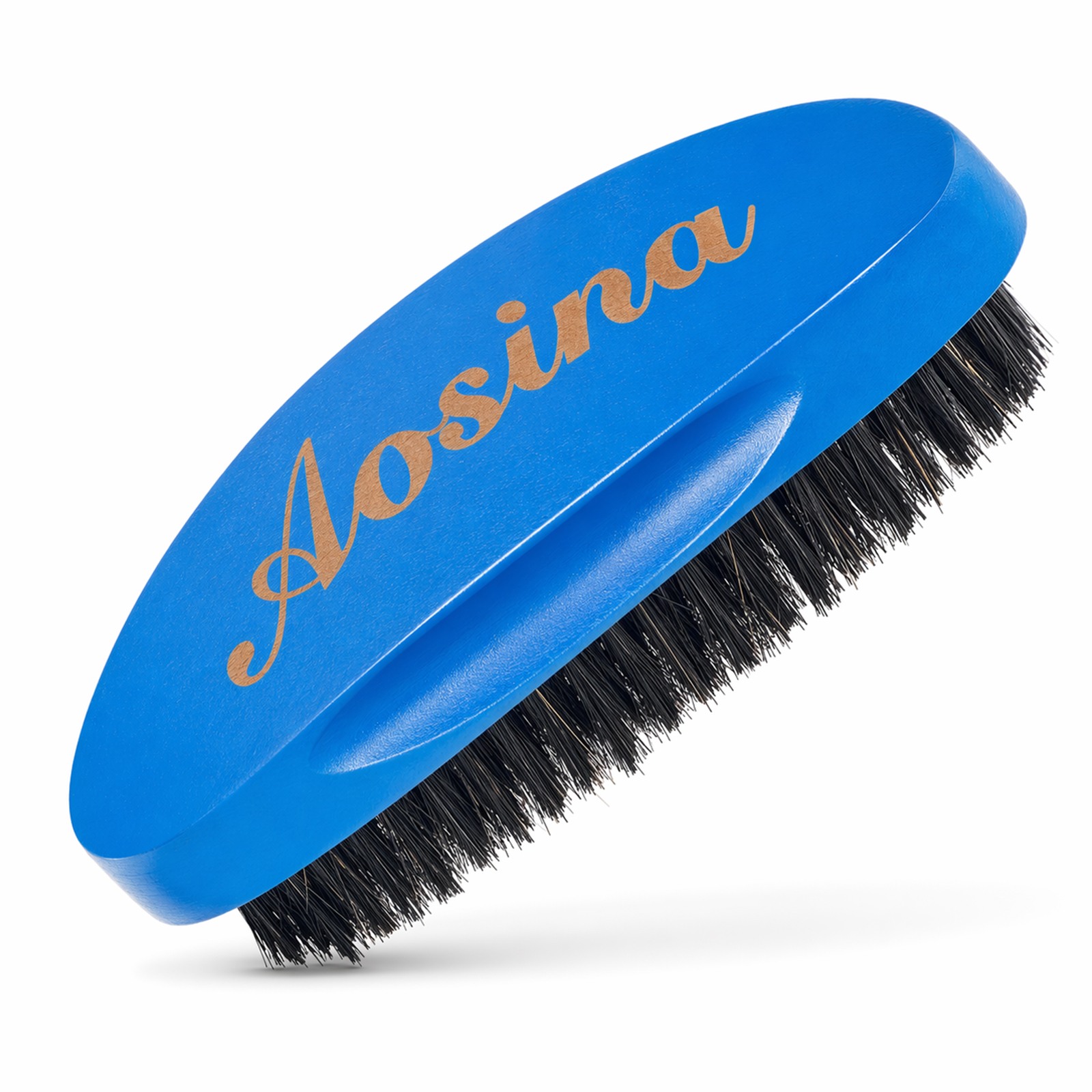
AOSINA Medium Hard Wave Brush (boar and nylon blend)
The angle problem, and three fixes
Because the skull curves away in two directions at the crown, the face cannot sit flat across it.
- Shorten the stroke. Near the center, think of dabbing outward rather than sweeping.
- Roll the wrist so the face stays tangent to the skull at the contact point.
- Use the corner deliberately. The outer edge gets into the ring around the whirl where a flat middle cannot.
Tilt also matters. Lean the brush slightly toward the direction you are stroking so the leading edge gets under the hair and the trailing edge does not scrape across it. A brush held dead perpendicular at the crown tends to skid.
Pressure is the last variable and the one people overdo. The scalp over the crown has less padding between skin and bone than the sides do. Press until the bristles reach the scalp, not until the skin moves. If you can feel bristles on bone, you are through the hair and into skin.
Forks, double crowns and honest limits
Two shapes cause most of the frustration, and both deserve a straight answer.
- A fork is a line where hair diverges instead of lying one way. Forks rarely close completely. What improves is the depth of the gap: brush each side in its own direction and never force one direction across the line.
- A double crown is two whirls. Treat them separately. Between them is a saddle where direction is ambiguous; brush that area outward toward the nearer whirl.
If your crown stays slightly open at the very center while the hair around it lies down, that is a normal outcome. Chasing that last centimeter with a firm brush and heavy pressure is how people end up with a crown that looks thin because it is irritated and broken, not because it is bald.
Forks in 360 Waves: What They Are and How to Work With Them
Match the tool to the job at the crown
Nothing here replaces getting the direction right, but the tool decides whether corrected strokes reach the scalp.
- Firmness first. If bristles never touch skin, no pattern appears. A blend like Medium Hard is the usual workhorse at the crown: it reaches through moderate density without scraping.
- Soft is the right call when the crown is sore or the hair is fine. It also carries product and finishes a pattern well.
- Width. A narrower face gives finer control in the ring around the whirl; a wider face blends the outer crown faster.
- Shape. A curved face wraps the crown with less wrist work; a flat face needs a roll to avoid touching along a line only.
AOSINA Soft Wave Brush (100% pure boar bristles)
If you use a hard brush at all, treat the crown as the place to back off. Hard bristles are for getting through density on the sides and back, not for pressing a swirl into submission.
How to Brush 360 Waves: Pattern, Angles and Direction
7 Row vs. 9 Row Wave Brush: Which Face Fits Your Head
Curved vs. Flat Wave Brush: Which Shape Fits You
Protect it: rag placement and stop rules
You can do everything above correctly and lose it in eight hours of sleep. Keep the knot and the seam off the swirl, tie evenly rather than tighter, and change your sleeping side so the crown is not compressed the same way every night. If your rag leaves a visible line across the crown in the morning, that line is pressure, not pattern.
Waves Not Coming In on the Sides: What to Check First
A crown that hurts is a crown that will fall behind, because you will start avoiding it. Three signals mean back off rather than push through.
- Tenderness the next morning. That is pressure, not effort paying off. Drop to a soft brush and light strokes.
- Redness that lasts more than a few minutes after brushing. Same cause.
- A patch that looks thinner over several weeks while you have been brushing harder. Reduce pressure and keep the routine consistent. If it keeps changing, have someone look at it instead of experimenting further.
A fair review point is four to six weeks of daily short outbound strokes with correct pressure. If the surrounding hair improved and the center did not, the variable left is your rag placement or your whirl's rotation, not your work rate. Change one of those, not three things at once.
Bottom line
Treat the crown as a direction problem: find the whirl, brush out from it in short strokes, never circle it, keep the face tangent to the skull, and lighten pressure instead of adding it. Then set the rag so nothing lands on the swirl while you sleep.
Firmness and shape come second. They decide whether corrected strokes reach the scalp, which is worth nothing if the strokes go the wrong way.
Starting from scratch, a set lets you keep one soft brush for sore days and one firmer brush for the ring around the whirl, which is how most people end up using two brushes at the crown.
AOSINA 3-Pack Wave Brush Set (Soft, Medium Hard and Hard)
Related reading
Wave TroubleshootingHow to Work on Forks in 360 Waves
Working on disconnected wave patterns? Inspect brushing angles, comb gently when needed and track your progress without chasing instant fixes.
Read article →Wave TroubleshootingWhy Are My Waves Not Coming In on the Sides?
Top waving but sides staying flat? Check haircut length, growth direction and brush contact before adding more pressure.
Read article → Wave Troubleshooting
Why Do My Waves Look Frizzy After Brushing?
Waves looking puffy after a brush session? Check pressure, firmness, direction and finishing before changing your whole routine.
Read article →BRUSH BASICSCurved vs. Flat Wave Brush: Which Shape Actually Fits Your Head
A curved body and a flat body put pressure on your scalp in different ways. Where each shape helps, where it fights you, and the four checks that tell you in two weeks.
Read article →