7-Row vs 9-Row Wave Brush: Which One Fits Your Head and Hair
Rows describe how wide a band of hair one stroke covers, nothing more. Who a 7-row brush suits, who a 9-row suits, and the four checks that tell you which one your head and hands actually want.
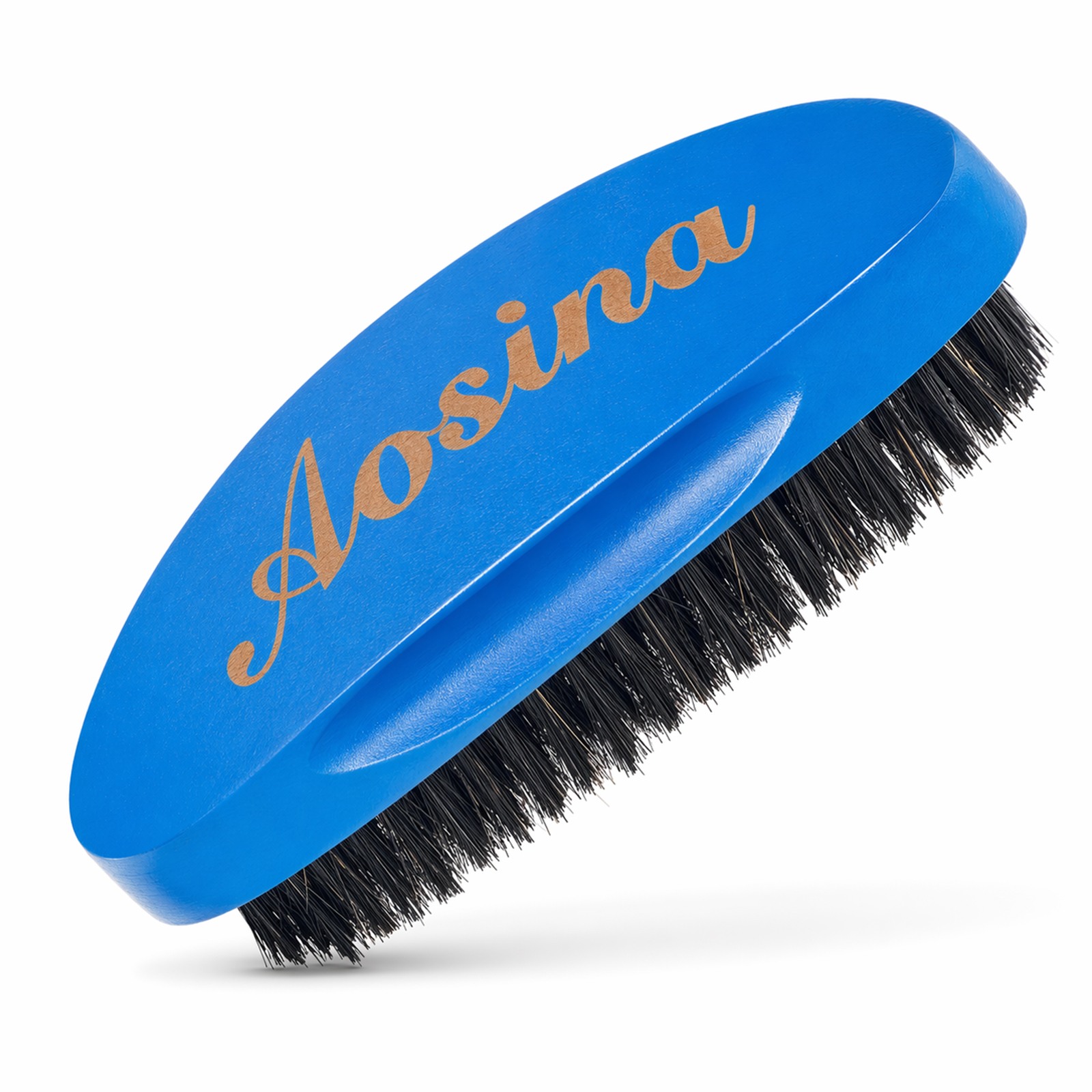
Row count is the most quoted number in wave brush shopping and the least useful one on its own. Two brushes with the same number of rows can feel like completely different tools. Two brushes with different numbers can give you the same result on the same head. What rows actually change is how much hair one stroke covers — and whether that helps depends on your hair length, density, and hand size.
So this is not a "7 is for this, 9 is for that" answer. It is the version that holds up when you are holding two brushes and cannot test either one first.
What rows actually measure
Rows are the strips of bristles running across the face of the brush. A 7-row brush has seven of those strips; a 9-row brush has nine; some makers go to eleven. Because the bristles are set in rows, adding a row widens the face by roughly one row's worth of spacing. That is the whole meaning: row count is shorthand for footprint — how wide a band of hair the brush touches in one pass.
It does not tell you how stiff the bristles are, how densely the tufts are packed, how long they are, or what they are made of. A 9-row soft boar brush and a 9-row all-nylon brush share a number and almost nothing else.
Nor is the number standardised: spacing and staggered rows vary, so a 9-row brush from one brand can be noticeably narrower than a 9-row from another. Treat it like a shirt size — useful within one brand, unreliable across brands.
Why rows matter less than firmness and pressure
A wave pattern is built from three things: contact, direction, and repetition. Contact is bristles reaching the scalp through your hair. Direction is your wrist and your angles. Repetition is showing up twice a day for months.
Rows only touch the first one, and only in width. They do not make bristles reach deeper. A soft, wide brush that skates across the surface is not training anything — it is rearranging the top layer and leaving the hair underneath alone. Firmness is what decides whether the bristles get to the hair that matters.
That is why a narrower, firmer brush can outwork a wider, softer one on the same head. If you have not settled that question yet, start there rather than here:
Pressure is the other half: a wide face with a heavy hand puts more force into a larger patch of scalp, which is how people end up sore at the crown and temples.
The order that works: firmness first, body shape second, footprint third. Direction is the part no brush can do for you:
How to Brush 360 Waves: Pattern, Angles and Direction — the half of this no brush can do for you.
Who a 7-row brush suits better
A narrower face is the detail brush, and on some heads it is simply the right tool for everything.
- Short hair. On a fresh cut, or in the first weeks of a wolf, there is not much length to reach through. A narrow face keeps the bristles on the scalp instead of bridging across the curve of your head.
- Precision zones. The hairline, the part line, the swirl at the crown, and the strip above the ears are small areas. A wide face spills over them; a narrow one lets you work an edge without pushing hair where you do not want it.
- Smaller hands and narrower heads. If a wide body hangs off the side of your palm, you grip to control it, and a gripping hand presses harder than a resting one.
- Thin or fine hair. Wide, soft faces tend to float on fine hair. Narrower faces keep more bristle per square inch in contact, which is the part that does the work.
The trade-off is honest: a narrow brush needs more passes to cover the whole head, so sessions run longer. If time is already tight, that cost is real.
AOSINA Soft Wave Brush (100% pure boar bristles)
Who a 9-row brush suits better
A wider face is a coverage tool, and once your hair has length the arithmetic changes.
- Longer hair in a wolf. Past the middle weeks, hair has weight and no longer snaps back on its own. A wider face carries your direction across the length of the hair in one stroke instead of working it in strips.
- Thicker density. More hair between the bristles and the scalp means each pass has to get through more.
- Larger palms. A wide body that sits flat in the palm lets your arm do the work instead of your fingers, which matters over a twenty-minute session.
- The back of your head. When you cannot see what you are doing, a wider face covers more of the area you are guessing at.
The trade-offs are the mirror image. A wide face is harder to keep even at the edges, clumsy on the hairline, holds more bristle mass to clean, and on very short hair it can bridge the curve of your head and never fully touch down. A wide brush bought early is not a head start — it is a brush that sits in the drawer until your hair catches up.
Rows and hair length across a wolf
Row count is not something you choose once and keep forever. It tracks your hair.
In the first weeks of a wolf, your hair is close to your head and a narrow face does everything you need. As length builds, the same brush works harder to reach the scalp, and you either add time or add footprint. That is the same logic as moving up a firmness, and the two decisions usually arrive together:
One warning: if you change footprint and firmness in the same week, you will not know which change helped and which caused the soreness. Change one, hold it for two weeks, then decide.
Some people keep two brushes on purpose — narrow for hairline and crown detail, wide for the sides and back — as long as both are firmness-appropriate.
How to test a new brush in the first two weeks
You cannot judge a brush from a product photo. Run a fair comparison at home instead: same session length, same products, same time of day, one variable changed — the brush. Then watch four things.
- Coverage per pass. Start at the crown and brush outward to one side. Did that one stroke cover the section, or did you have to go over it twice in slightly different places?
- Hand fatigue. Does your thumb or wrist tire before the session ends? If yes, the body is too big for your grip, regardless of how well it covers.
- Hairline behaviour. Does the hairline stay where you put it, or does the brush push it out of line every session? Losing the edge is the classic cost of too much footprint.
- Next-morning scalp. Any tenderness at the crown or temples? That is almost always pressure or firmness, not rows. Do not blame the width for a hand that is pressing too hard.
Read the pattern. Skating with no tenderness means not enough firmness. Patchy coverage with a tired hand means the face is too wide for you. Sore scalp with good coverage means lighter pressure, not a different brush.
The four mistakes people make with row counts
More rows means faster waves. No. Rows change how much hair one stroke covers. How fast a pattern trains is set by frequency, direction, and months of consistency. Nobody has ever gotten waves in three weeks because of a wider brush.
Buying wide to future-proof for length. A wide face on short hair bridges the curve of your head instead of pressing into it. You pay for coverage you cannot use yet, and you lose the precision you actually need at the hairline.
Assuming the number means the same across brands. Different spacing, staggered rows, different bristle diameters. Compare within a brand, or compare the actual footprint.
Ignoring the body shape. A curved palm body follows the shape of your head, so the bristles stay in contact as you move around the sides. A flat body relies on your wrist to keep the angle. Footprint and shape interact, and shape is the part most listings under-explain:
Palm vs. Long Handle Wave Brush: What the Handle Changes — why the body shape does half the work.
How to choose when the listing does not give a row count
A lot of palm brushes never publish row counts at all, which is fine once you know what to look at instead.
- Compare the footprint to your palm. Body width relative to the width of your hand tells you more than a row number, because your hand has to control it.
- Read the firmness and material before the size. Those two decide whether the bristles reach the scalp at all.
- When in doubt, go narrower. A narrow brush can cover a wide area with extra passes. A wide brush cannot be made narrow for the hairline.
If the real question is firmness rather than width, a set removes the guessing. Ours is three palm brushes — Soft in pure boar, the middle one in a boar and nylon blend, and Hard in all nylon — so you can find the one your hair responds to instead of ordering blind. The middle brush in that set is Medium Hard, not Medium, which matters when you are comparing it to anything else:
AOSINA 3-Pack Wave Brush Set (Soft, Medium Hard and Hard)
AOSINA Medium Hard Wave Brush (boar and nylon blend)
Bottom line
Rows describe footprint. Footprint decides how much hair one stroke covers, and how much control you give up at the edges. It does not decide quality, firmness, or how fast your hair trains.
Choose in this order: the firmness that reaches your scalp, the body shape that fits your hand, then the width that matches your hair length right now. If your current brush covers the sections you work, your hand does not tire, and your pattern is still moving forward month to month, row count is not your bottleneck — and a different one will not move it.
If you are stuck between two widths, take the narrower one and put the money into the firmness that actually fits your hair. That is the change most people can feel in the first week.
Related reading
BRUSH BASICSCurved vs. Flat Wave Brush: Which Shape Actually Fits Your Head
A curved body and a flat body put pressure on your scalp in different ways. Where each shape helps, where it fights you, and the four checks that tell you in two weeks.
Read article →Wave TroubleshootingCrown Brush Pattern: Why the Swirl Is the Last Section to Close
The crown is where hair direction changes inside one brush width, so normal strokes skip it or fight it. How to find your whirl, the stroke pattern that lays it down, and where to stop.
Read article → BRUSH CARE
How to Clean a Wave Brush with a Wooden Handle
Remove loose hair first, keep the wooden handle out of standing water, and let the brush dry in moving air. Avoid soaking or unconfirmed cleaning treatments.
Read article → WOLFING
Wolfing Weeks 5 to 8: When to Move Up a Brush and When Not To
The middle weeks of a wolf are where it gets built or lost. What changes in week 5, when moving up a firmness actually makes sense, the right way to add pressure, and the three questions to ask at the week-8 checkpoint.
Read article →