How to Brush 360 Waves: Pattern, Angles and Direction
Most people brush hard and in circles. The pattern only forms when every stroke follows the same direction. Here is how to brush by section, at what angle, and for how long.
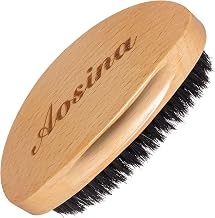
The short answer: you get waves by brushing the same direction, over and over, until the hair learns to lie that way. The direction matters more than the force. Every stroke on a section should point the same way, starting from the crown and working outward toward your hairline, and the whole session should end with compression so the hair sets in the shape you just brushed it into.
If you take one line from this article: same direction, every stroke, then compress. Circular brushing and random strokes are the two most common reasons people brush daily for months and see very little.
Moisture comes before brushing
Brushing dry hair is the fastest way to break strands and stall progress. Before a session, your hair should feel soft and pliable, not brittle.
A simple order that works for most people:
1. Lightly damp the hair with water or a spray bottle, or apply a small amount of moisturizer.
2. Work it through with your fingers or a wide-tooth comb so the hair is evenly conditioned.
3. Only then start brushing.
If your hair feels dry halfway through a session, add a little more moisture rather than brushing harder.
The pattern: crown to hairline
360 waves start at the crown and run outward. That is the direction you are teaching your hair, so the same logic applies to your strokes:
- Find your crown — the point where your hair grows outwards in all directions.
- Brush **away from the crown** toward the front, sides and back.
- Work one section at a time instead of sweeping the whole head with every stroke.
- Finish each section before moving on, so the direction in that section is consistent.
Do not rotate the brush mid-section. The goal is repetition of one direction, not coverage of the whole scalp at once.
Angles and direction by section
Angle is simply how you hold the brush as the hair meets the bristles. Matching the angle to the section is what stops you from fighting your own hair line.
| Section | Stroke direction | How to hold the brush |
|---|---|---|
| Crown | Outward from the centre, in whichever direction that area naturally flows | Brush nearly flat against the scalp, short strokes, light pressure |
| Top / front | From crown forward toward the hairline | Slight forward tilt, keeping bristle tips in contact with the hair |
| Sides (left and right) | From crown down and slightly forward, following the hairline | Angle the brush to lie along the side of the head, not across it |
| Back | From crown down toward the nape | Longer, slower strokes; the palm handle helps here because you cannot see the area |
| Hairline / edges | Short strokes in the direction the section flows | Reduce pressure — edges are where irritation and breakage start |
Two rules cover most of it: stroke direction always follows outward from the crown, and pressure stays light enough that you could keep going for several minutes.
Working pass and finishing pass
A full session is usually two different jobs, and they do not need the same brush:
- **Working pass.** The firmer brush (medium hard, or hard for long dense hair) does the training: it moves the hair into your direction.
- **Finishing pass.** A soft brush at the end smooths the surface and lays the pattern flat, without adding friction after the hair has already been worked.
If you own one brush, that is fine — use it for both passes and accept a compromise. If you own two, splitting the passes is the most useful way to use them. Compare the three AOSINA firmness levels
Compare the three AOSINA firmness levels
How long each session should be
Long sessions are not the goal. Consistent, well-directed ones are.
- **10 to 15 minutes** a day is a realistic baseline for most people.
- **Two shorter sessions** (for example morning and evening) often beat one long one, because you reinforce the direction twice.
- **Stop** when your scalp feels tender. Soreness means too much pressure, too much duration, or a brush that is too firm for your current hair length.
- **Always finish with compression** — a durag or wave cap for at least 20 to 30 minutes, and overnight where possible.
If you are short on time, a shorter session with a correct direction is worth far more than a rushed long one.
Wet or dry?
Damp, never soaked. Water makes hair more flexible, which helps it take a new shape, but hair that is very wet stretches and breaks more easily and the bristles lose their grip.
The practical approach: damp the hair, work in a small amount of moisturizer or leave-in, brush, then let it dry under compression. Brushing completely dry hair is hard on the strands; brushing soaking wet hair is not much better.
Common technique mistakes
- **Brushing in circles.** There is no single direction, so the hair never learns one.
- **Changing direction each session.** Consistency across days is what makes a pattern. Pick your direction and keep it.
- **Pressing too hard.** Contact is what matters. Pressure mostly creates irritation and breakage.
- **Brushing dry hair.** The most common cause of stalled progress.
- **Skipping compression.** Without it, the hair springs back and you rebuild the same progress next time.
- **Using a brush that has gone too soft for your length.** If the brush glides over the surface without moving hair, it has stopped doing its job — see .
- **Brushing the edges aggressively.** Thin, delicate hair around the hairline does not need the same pressure as the crown.
how to tell it is time to move up a firmness level
The brushes that fit each pass
- **Right after a cut (soft, short hair):** soft bristles for comfortable contact and daily laydown.
- **The main training pass once hair grows out:** medium hard, the working brush for most routines.
- **Long, thick or dense growth:** firm nylon bristles for heavier passes.
- **Working pass plus finishing pass without buying twice:** the three-brush set.
Buy the AOSINA Soft Wave Brush on Amazon
Buy the AOSINA Medium Hard Wave Brush on Amazon
Buy the AOSINA Hard Wave Brush on Amazon
Buy the AOSINA 3-Pack Wave Brush Set on Amazon
Frequently asked questions
How often should I brush 360 waves?
Daily, and more than once a day if your scalp is comfortable with it. Two shorter sessions reinforce the direction better than one long session. Consistency across days matters much more than total brushing time.
How long should I brush my waves each day?
Around 10 to 15 minutes is a realistic baseline. Stop if your scalp feels sore — that usually means the pressure, the duration or the firmness is too much.
Do you brush waves in circles?
No. Circular brushing means there is no consistent direction, and the hair never learns one. Brush outward from the crown toward your hairline, in one direction per section.
Should I brush my waves wet or dry?
Damp, not soaked. Moist hair is more flexible and takes a shape more easily, but very wet hair stretches and the bristles lose grip. Dry hair breaks and sets back your progress.
Which brush should I use to brush in the pattern?
A medium hard brush is the usual working brush for the training pass, with a soft brush for finishing. Use a soft brush alone right after a cut, and a hard brush if your hair has grown long and dense.
Do I need to brush in a certain direction for 360 waves?
Yes — everything radiates outward from the crown. Stroke direction follows the hair as it grows, and it should be the same direction every session.
Where to go next
How to Get 360 Waves: Step-by-Step Beginner's Guide — the routine this technique belongs to.
How Long Does It Take to Get 360 Waves? — what a realistic timeline looks like.