Curved vs. Flat Wave Brush: Which Shape Actually Fits Your Head
A curved body and a flat body put pressure on your scalp in different ways. Where each shape helps, where it fights you, and the four checks that tell you in two weeks.
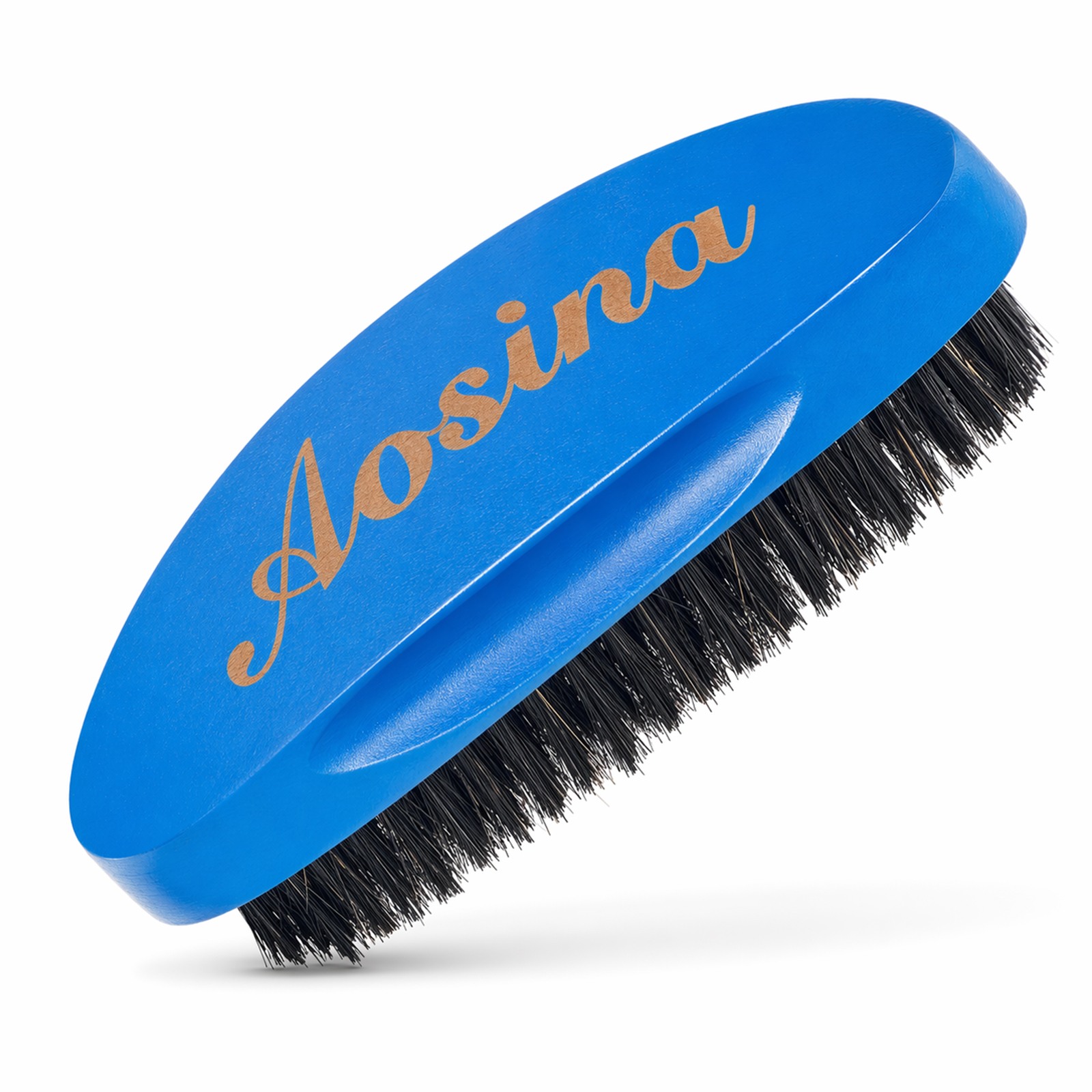
Ask what wave brush to buy and the answer usually starts with firmness: soft, medium hard, hard. That is the right first question, because firmness decides whether the bristles reach your scalp at all. But there is a second question sitting right behind it that gets far less attention, and it changes how the brush feels in your hand every single session: is the body curved or flat?
Curved versus flat is not a quality ranking. Both shapes are sold to the same people, and both can produce a pattern. What differs is where the pressure lands, how much of your scalp the bristles touch at any one moment, and how much of the work your wrist has to do. This is the version of the answer that is useful when you are holding one brush in each hand and cannot try either of them first.
Two curves that get confused
When someone calls a brush curved, they could mean either of two things, and the difference matters more than the word suggests.
- Curved face. The tips of the bristles sit on a shallow arc, so the face wraps slightly around the curve of your head.
- Curved body. The wood or plastic body is arched, so the brush rocks along your palm as you stroke. The face on top can be flat or contoured, independently of the body.
What you feel on your scalp is the face. What you feel in your hand is the body. When people say a brush "fits my head", they are usually describing the body. When they say it "gets the sides", they are usually describing the face. A brush can have one and not the other, so read the product description for which curve it is actually claiming.
What a curved body does to pressure
A curved body cannot sit flat in your palm, so it rolls. At any instant, only a strip of the face is pressing firmly against your head and the rest of it is lighter. As you roll, that strip travels across the section instead of the whole face landing at once.
Two practical consequences follow. First, pressure is concentrated. That is good for getting through dense hair, and unforgiving if you have a heavy hand: lean on a curved brush the way you lean on a flat one, and that strip becomes a line of real force, which your scalp will report the next morning. Second, direction comes from wrist rotation rather than from sliding your arm sideways. Once that clicks, the brush follows the shape of your head rather than fighting it, because your wrist is doing the steering.
The honest cost is a learning period. For the first session or two a rolling stroke feels like the brush is skating, and most people over-correct by pressing harder. Pressing harder is the wrong fix; rolling further is the right one. If you have never used a curved body before, expect the stroke to feel unfamiliar on day one and settled by day ten.
AOSINA Medium Hard Wave Brush (boar and nylon blend)
What a flat body is good at
A flat face spreads force across the whole band at once, so no single strip takes the load. That single property produces most of the flat shape's advantages.
- Even pressure. For a heavy hand, a flat face is forgiving in a way a curved one is not.
- Predictable lines. Straight-back and straight-forward patterns are easier to keep straight when the brush itself does not roll.
- Coverage. A wide flat face covers a broad band in one pass, which matters once your hair is long enough that every stroke has to travel the length of it.
- Nothing to learn. The stroke is the same on the first day as on the hundredth.
None of that is a consolation prize. If your pattern is already established, you brush in straight lines, and your hand is steady, a flat brush does the job with fewer things to think about. Plenty of people get where they want to go with one.
Where each shape fights you
This is the part that never makes it into product copy.
A curved body struggles in three places:
- The crown. The swirl sits where your head curves away in two directions at once. A rolling brush can walk off the spot if you do not shorten your stroke there.
- The hairline. A curved face makes contact in the middle, so the outer edge of the face does less work. Working an edge cleanly means using the side of the face deliberately, not just brushing near it.
- Impatience. If you roll too little, the brush skates; if you roll too much, it digs. The window is narrower than on a flat brush.
A flat body struggles in three places too:
- The sides. Your head is closer to a cylinder at the temples than to a flat plane. A flat face meets that curve along a line and leaves air at both edges of the band. You feel firm contact in the middle and assume the section is covered, when the hair above and below that line got noticeably less pressure.
- The back. You cannot see it, so you work by feel. A flat face gives your hand less information about where it is actually touching.
- Very round heads. A flat body on a strongly rounded skull rocks end to end, and the ends get more pressure than the middle.
Notice that both lists are about contact geometry, not quality. Neither shape is better made than the other. They just distribute force differently, and each one is a poor match for a different part of your head.
The sides and back are where the difference shows up
If you have spent a month on the sides and watched the front come in while the sides stayed flat, the shape of your brush is one of the first things to check, along with brushing direction and how your durag sits.
Waves Not Coming In on the Sides: What to Check First
On the back, where you work blind, the body shape decides how much your hand can tell you. A brush that rolls in your palm reports the contour of your skull back through your wrist. A flat body riding across a curve reports almost nothing, so you keep going over the same area and under-working the next one. That is one reason two people with the same hair and the same routine get different results on the back: one of them is brushing what they can feel, the other is brushing what they can see in a mirror.
Match the shape to your stage, not to your taste
Hair length changes which shape makes sense, because it changes what the brush has to do.
- Fresh cut through the first weeks of a wolf. There is little length to carry a direction, so contact does almost all the work. This is where a curved face earns its keep, and where a soft brush suits thin or fine hair.
- The middle and late weeks of a wolf. Hair now has weight and holds a direction on its own. A wider face that covers more ground per stroke starts to matter more than the wrap.
- Waves already set. You are maintaining, not building. Whatever shape you find comfortable is the right answer, provided you are not losing the hairline.
AOSINA Soft Wave Brush (100% pure boar bristles)
What no shape can do is fix a direction problem. If your strokes do not follow the pattern you want, a better brush just gets you to the wrong place faster.
How to Brush 360 Waves: Pattern, Angles and Direction
And firmness still comes first. A curved body in a firmness that does not reach your scalp will not save you, any more than a flat one will.
Soft vs. Medium vs. Hard Wave Brushes: Which One Do You Need?
How to test a shape in two weeks
Pick two brushes that differ mainly in shape, keep everything else identical, and watch four things.
- First-stroke coverage. Start at the crown and brush outward once. Did that single stroke cover the section, or did you have to go over it in slightly different places?
- Contact across the whole face. Mid-stroke, can you feel the entire face of the brush loaded, or only part of it? Lifting at one edge is the signature of a shape that does not match your head there.
- Hairline behaviour. Does the hairline stay where you put it, or does every session push it out of line?
- Next-morning scalp. Any tenderness at the crown or temples is pressure or firmness, not shape. Do not blame the geometry for a hand that is pressing too hard.
Change only one thing at a time. If you switch shape and firmness together, two weeks later you will know that something improved and you will not know which part did it.
Palm vs. Long Handle Wave Brush: What the Body Shape Changes
Bottom line
If your problem is contact on the sides and crown, you are willing to spend a week learning a rolling stroke, and you tend to press gently, a curved body is the better tool. If your problem is coverage and consistency, your pattern is already set, and your hand is heavy, a flat body is the more forgiving choice.
Decide in this order: the firmness that reaches your scalp, the shape that matches your head where you struggle, then the width that matches your hair length right now. Buying in any other order means paying for a feature you cannot use yet.
If you are genuinely torn, borrow or buy one of each in your normal firmness and run the two-week test. It is a slower way to decide and a much cheaper way to be wrong.
AOSINA 3-Pack Wave Brush Set (Soft, Medium Hard and Hard)
Related reading
BRUSH BASICS7-Row vs 9-Row Wave Brush: Which One Fits Your Head and Hair
Rows describe how wide a band of hair one stroke covers, nothing more. Who a 7-row brush suits, who a 9-row suits, and the four checks that tell you which one your head and hands actually want.
Read article →Wave TroubleshootingCrown Brush Pattern: Why the Swirl Is the Last Section to Close
The crown is where hair direction changes inside one brush width, so normal strokes skip it or fight it. How to find your whirl, the stroke pattern that lays it down, and where to stop.
Read article → BRUSH CARE
How to Clean a Wave Brush with a Wooden Handle
Remove loose hair first, keep the wooden handle out of standing water, and let the brush dry in moving air. Avoid soaking or unconfirmed cleaning treatments.
Read article → WOLFING
Wolfing Weeks 5 to 8: When to Move Up a Brush and When Not To
The middle weeks of a wolf are where it gets built or lost. What changes in week 5, when moving up a firmness actually makes sense, the right way to add pressure, and the three questions to ask at the week-8 checkpoint.
Read article →