Wave Brush Brands Compared: What Actually Differs
Most brand comparisons rank logos. What actually varies is bristle material, firmness consistency, handle shape and durability — so here is how to compare any two brushes yourself.
The short answer: brand changes the details; firmness changes the result. Two brushes from different brands with the same real firmness will do broadly the same job on the same hair, while two brushes from the same brand in different firmness levels will not. So the useful comparison is not "which brand is best" — it is "which brush, at which firmness, for my hair length right now".
Full disclosure before we go further: we make one of the brands in this category. We have tried to keep the criteria below the same ones we would want applied to our own brushes.
Why brand matters less than firmness
Firmness is what your hair actually responds to. It decides how much pull the bristles put into the hair, which is the only force that trains a pattern. Everything else — the handle, the finish, the logo, the packaging — changes how the brush feels in your hand or how long it lasts, not what it does to your hair.
The practical consequence: if you own a brand's soft brush and your hair has grown out, switching brands at the same firmness will not fix it. You need a firmer brush, from anyone.
What actually differs between brands
These are the variables worth comparing, and they are all checkable from a product listing:
| Variable | Why it matters | What to look for |
|---|---|---|
| Bristle material | Nylon, boar and mixed bristles feel different and wear differently | A listing that states the material plainly |
| Stated firmness | The main driver of how a brush works on your hair | A clear soft / medium / hard rating rather than vague words like "pro" |
| Firmness consistency | Whether the brush you buy next year matches the one you liked | Brands that use stable naming instead of renamed variants |
| Bristle density | How evenly pressure spreads across the scalp | A densely packed head, described honestly |
| Handle shape and grip | How controllable the brush is on the crown, back and sides | A palm or curved handle for control in areas you cannot see |
| Durability | How long bristles hold shape before they splay | Reviews that mention months of use, not days |
| Price | Buys materials and longevity, not results | A price you can justify for a tool you use daily |
Notice what is not on this list: the number of products in the range. A large catalogue is not a quality signal, and neither is a small one. It just tells you how the brand chose to organise itself.
Torino Pro: what people search for
Torino Pro is one of the most searched brand names in this category, and the searches themselves tell you something useful about how the brand is bought. People search for the brand plus a firmness word, and also for brand plus a number — which reflects the brand's practice of selling numbered firmness models rather than only using words like soft, medium and hard.
Two practical takeaways if you are comparing against a numbered range:
- **The number is a firmness indicator, not a ranking.** Buying the highest number does not buy you better waves; it buys a firmer brush, which is only right if your hair length needs it.
- **You still have to match it to your hair.** Before buying any numbered model, you need some way of translating that number into a feel: soft, medium or firm — and then asking whether that is what your hair needs today.
We do not publish a number-to-number equivalence table for other brands, because we cannot verify those relationships, and a wrong conversion is worse than no conversion.
Royalty: what people search for
Royalty is the other brand name that comes up constantly in wave brush searches, and the pattern is the same: people search the brand plus a firmness descriptor. That is a sign of the same underlying behaviour — brand gets you to a shortlist, firmness gets you to a decision.
When comparing any brand to another, use the same test you would use in a shop: bristle length, how densely packed the head is, and how much pressure it takes before the bristles start to bend away from the hair. Those three observations translate across brands far more reliably than descriptions do.
AOSINA: what we make, and why so few products
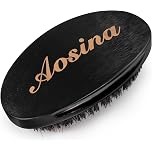
We make four products: a Soft, a Medium Hard, a Hard, and a three-brush set containing all three firmnesses. Each one uses a wooden palm-style handle, and the Hard brush uses firm nylon bristles.
We deliberately sell a small range, for two reasons:
- **Firmness is the only variable that changes the outcome.** A range with twenty variations mostly creates the illusion of choice, because most of those variations are the same job.
- **We would rather state less than guess.** Where we cannot verify a specification, we do not claim one. That is why you will not find invented numbers, invented materials or invented performance claims on our product pages.
Buy the AOSINA Soft Wave Brush on Amazon
Buy the AOSINA Medium Hard Wave Brush on Amazon
Buy the AOSINA Hard Wave Brush on Amazon
Buy the AOSINA 3-Pack Wave Brush Set on Amazon
See all four AOSINA brushes side by side
The problem with "strength numbers"
Numbered firmness systems are useful inside a single brand: if you know that one number feels right for your hair, the next one up or down is a predictable step. They stop being useful the moment you compare across brands, because there is no industry standard for what any number means.
That is why "which is firmer, brand X number 350 or brand Y hard?" has no reliable answer you can get from a listing. What you can do instead is compare the things that do carry across brands:
- **Bristle length.** Shorter bristles reach closer to the scalp; longer bristles pass through hair.
- **Density.** More bristles per square centimetre means pressure spreads more evenly.
- **Resistance.** Press a brush into the back of your hand. If the bristles fold away easily, it is a lighter brush than one that stays upright.
How to compare any two wave brushes in 30 seconds
1. Check the stated firmness. If neither listing states one in plain words, that is your first problem.
2. Check the bristle material. Stated material means the seller knows their product.
3. Check bristle length. Short means wave brush; long means it is really a grooming or detangling brush.
4. Check density. A sparse head gives uneven pressure.
5. Check the handle. You need control on the back and crown, not just the front.
6. Check whether the reviews mention hair texture and length. Those are the reviews that apply to you.
7. Ignore the ranking language. "Best", "pro", "advanced" and "salon-grade" are marketing, not specifications.
Where brand research usually goes wrong
- **Reading ranking listicles.** Most are affiliate pages ordered by commission, not by how the brush performs.
- **Assuming the most reviewed product is the best.** It usually means the most advertised.
- **Buying on firmness words alone across brands.** "Hard" from one brand and "hard" from another are not the same brush.
- **Trusting a hardness number conversion table** built by someone who has never held both brushes. We include this here because such tables are common, including ones that favour brands like ours. They should not be trusted.
- **Changing brand to fix a firmness problem.** If your brush has stopped making contact, you need a firmer brush — not a different logo.
Frequently asked questions
Which wave brush brand is best?
There is no best brand, because the result comes from matching firmness to your hair length. A correctly matched brush from any reasonable brand will outperform a mismatched brush from a famous one.
Is Torino Pro better than other wave brush brands?
Torino Pro is one of the most searched names in the category, and its numbered firmness models are widely bought. Whether it is better for you depends on whether the firmness you pick matches your hair length — the same test that applies to every brand.
What do the numbers on wave brushes mean?
They are firmness indicators within a single brand's range, not a universal scale. A number tells you where a brush sits relative to other brushes from the same brand. It does not translate reliably between brands.
How do I compare two wave brushes from different brands?
Compare stated firmness in plain words, bristle material, bristle length, bristle density and handle shape. If a listing will not state the firmness or the material, treat that as a warning sign.
Do expensive wave brushes get you waves faster?
No. Price buys materials, durability and finish. Firmness matched to your current hair length is what affects how your hair responds, and consistency is what makes a pattern hold.
Where to go next
Best Wave Brush: How to Choose One for Your Hair — a three-step way to choose without brand loyalty.