Can You Over-Brush Your Waves? 3 Signs You Are Doing Too Much
Yes, you can over-brush 360 waves. The three signs - stubborn frizz, broken short hairs, and a scalp that stays irritated - what a sensible daily limit looks like, and how to recover when you have overdone it.
The short answer
Yes. You can over-brush your waves. Brushing is a stimulus - repetition that trains direction, force that compresses the pattern - and every stimulus has a dose where the benefit stops and the damage starts. Over-brushing rarely announces itself in the moment. Nobody takes one giant stroke and ruins a pattern. It accumulates: a few hundred extra strokes here, a little more pressure there, day after day, until your hair and scalp start answering back.
The tricky part is that over-brushing feels exactly like good brushing while you are doing it. Both feel productive. The difference shows up later - in frizz that will not settle, in short broken hairs, in a scalp that is still angry the next morning. Reading those signals correctly is the only reliable way to find your personal limit, so this article is about the signals first and the numbers second.
What over-brushing actually is (and what it is not)
Brushing does two jobs: it trains hair to lie in one direction per section, and it compresses the trained hair so the pattern sets and holds. The training part works through sheer repetition at low force. That is why the advice is always to brush consistently - the pattern is built by thousands of light, correct strokes, not by a few violent ones.
Over-brushing, then, is not a fixed number of minutes. It is more stimulus than your hair can recover from between sessions. The dose has four multipliers: how many strokes you take, how much pressure you use, how firm your brush is, and what condition your hair and scalp are in that day. Change any one of them and the same thirty minutes turns productive or destructive. This is also why individual differences here are real, not an excuse - someone with thick, coarse hair and a broken-in medium brush can absorb far more brushing than someone three days into a fresh haircut with a stiff brush. Same minutes, completely different load.
Signal 1: frizz that keeps coming back
Some frizz right after a session is normal, especially over fresh growth and along the hairline. The over-brushing version is different: the frizz comes back every single day no matter how carefully you finish, the surface looks puffy instead of laid, and it shows up worst exactly where you brush hardest.
Before you blame the brushing, rule out your finishing routine - a lot of so-called frizz is really a finishing problem that a better routine fixes within a week. But if your finishing is already consistent and the frizz persists, the brushing dose itself is the suspect. Hair that is being trained faster than it can settle responds by puffing up.
Waves Looking Frizzy After Brushing? Fix the Finish First
Signal 2: short, broken hairs where you brush most
Stand in good light and look at your hairline, your crown, and whatever spot you work hardest. Broken hairs are short, uneven, and they stick out of the pattern instead of lying in it. Do not confuse them with new growth - new growth is also short, but it appears in an even band along the growth line and lies in the same direction as its section. Breakage clusters where the brush works hardest, and those hairs often feel brittle or kinked at the tip.
One more check before you blame your dose: look at the brush itself. Worn, frayed, or hooked bristles shred hair no matter how gently you brush, and they are the most overlooked cause of breakage. If the brush checks out and breakage keeps showing up in the same spots, either your pressure is too high or your brush is too firm for your current stage.
When to Replace Your Wave Brush
Medium vs. Medium Hard Wave Brush: Which One Fits Your Stage
Signal 3: a scalp that stays red, tight, or tender
Some sensation during brushing is normal - you are working the scalp, and a long session can leave light tenderness that fades within the day. The over-brushing signal is different: the scalp is still red or tender the next morning, it feels tight, it stings when you pull the durag off, or brushing stops feeling like pressure and starts feeling like sanding.
Pain during brushing is its own topic with its own causes - pressure habits, a brush that is too firm for your stage, wet hair, worn bristles - and we cover those four separately. What matters here is the after-signal: a scalp that never gets a calm day is not being trained, it is being irritated, and a chronically irritated scalp works against every goal you have. Rest is not lost progress.
Scalp Pain From Brushing: 4 Causes and When to Stop
So what is a sensible daily limit?
Nobody can hand you one universal number, because the honest answer depends on your hair, your brush, and your stage. But ranges and logic exist, and they beat brush-until-it-hurts as a starting point.
- Wolfing or rebuilding the pattern: two or three sessions of 10-15 minutes spread across the day beat one long grind. Total time matters less than total recovery.
- Maintaining an established pattern: one or two sessions of 5-10 minutes is usually plenty. Maintenance brushing is closer to tuning than construction.
- Fresh haircut or heavy new growth: shorter, lighter, more frequent. Fresh hair bends easily and breaks easily too.
- Firmer brush: fewer minutes and lighter pressure - not the same routine with a stiffer tool.
Notice what sets the ceiling: recovery, not discipline. If the three signals above show up, you have found your personal limit, no matter what anyone else's routine claims. For the full frequency question, including how session length shifts between wolfing and maintenance, see the brushing guide.
How to Brush 360 Waves: Angles, Pressure, and Frequency
If you have already overdone it
Take two or three easier days: shorter sessions, lighter pressure, or a full day off if your scalp is still tender. Moisturize, keep the durag or wave cap on at night, and let the compression do the work while the surface calms down. The pattern will not vanish in three days - trained waves hold much better than people fear, and a short deload usually costs less than you think.
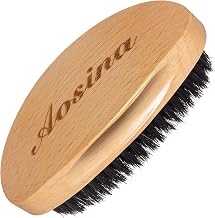
This is also the right moment to drop to a softer brush for a few sessions. A soft, pure boar bristle brush still trains direction and spreads your natural oils - it just does it with less abrasion, which is exactly what an over-worked scalp wants. Once the frizz settles and the tenderness fades, step your routine back up gradually instead of jumping straight back to where you left off. If you are wolfing, the week-by-week plan helps you pace the build-up.
AOSINA Soft Wave Brush (100% pure boar bristles)
Wolfing Week by Week: What to Do in Weeks 1-4
The bottom line
Over-brushing is real, and it is one of the few wave mistakes that feels like virtue while it happens. Watch for frizz that never settles, breakage clustered where you brush hardest, and a scalp that never gets a calm morning. Keep sessions consistent instead of heroic, and treat rest as part of the training rather than a break from it. Waves are built by what you repeat comfortably for months - not by what you survive in one evening.
Related reading
Wave TroubleshootingWhy Do My Waves Look Frizzy After Brushing?
Waves looking puffy after a brush session? Check pressure, firmness, direction and finishing before changing your whole routine.
Read article →Wave TroubleshootingWaves Fall Apart in Humidity: Why It Happens and What Helps
Moist air softens the set you brushed in and hair drifts back toward its natural curl. Why humidity frizz happens, the order that holds up before you go out, and how to reset when you get home.
Read article →Wave TroubleshootingScalp Pain From Brushing Waves: 4 Causes and When to Stop
Brushing waves should feel like pressure, not pain. The four usual causes of scalp pain from brushing - pressure, brush firmness, the moisture point, and worn bristles - and the moments when the right move is to stop.
Read article →Wave TroubleshootingWaves After the Gym: What to Do in the First 20 Minutes
Sweat softens the set you brushed in and sits at the roots where brushing reaches last. The reset order for the first 20 minutes after a workout, how to handle sweat on non-wash days, and why the post-gym session belongs to a soft brush.
Read article →