Boar Bristle vs Nylon Wave Brush: Which Bristle Material Do You Need?
Bristle material changes how a brush feels on your scalp and how long it holds its stiffness — not how waves form. Here is the honest difference between boar, nylon and blended heads.
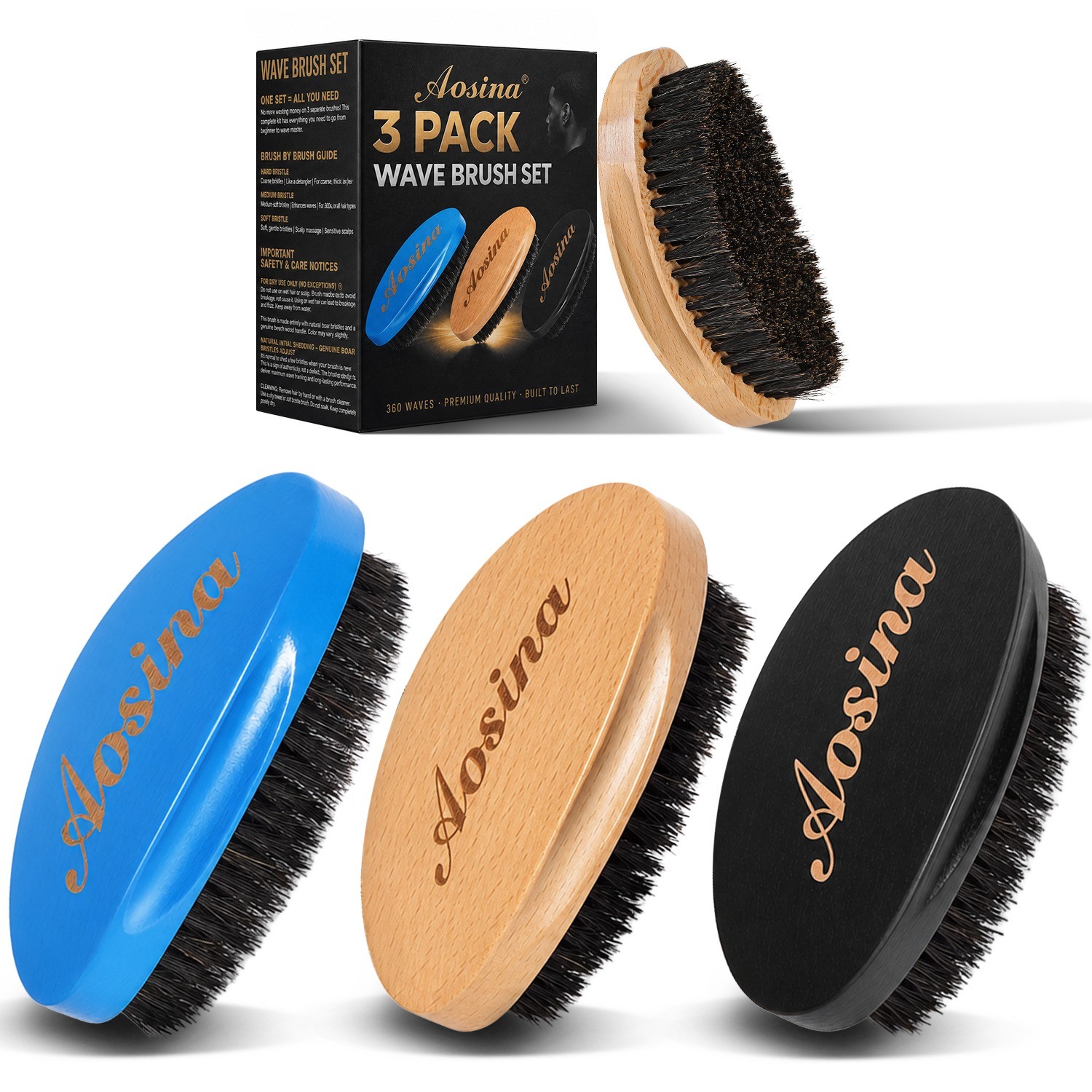
The short answer: bristle material does not create your wave pattern — firmness and consistency do. What material decides is how the brush feels against your scalp, how long it keeps its stiffness, and how much care it needs. Boar bristles are natural, finer and more flexible, so they give a softer, gentler pull. Nylon bristles are uniform and stiffer, so they put more pull into each stroke and hold their shape longer. Blended heads sit between the two. None of the three is better than the others — they suit different hair and different stages.
If you would rather feel the difference between the three materials on your own hair instead of reading about them, the set below contains one of each:
Buy the AOSINA 3-Pack Wave Brush Set (Soft, Medium Hard & Hard) on Amazon
What wave brush bristles are actually made of
Boar bristle is natural hair from a boar. The filaments taper toward the tip and vary slightly in thickness, which is why a boar head tends to feel softer and more forgiving against the scalp than a synthetic head at a comparable firmness. It is also why a natural head can lose a few bristles early on and then settle down.
Nylon bristle is extruded synthetic filament. It is uniform in thickness, does not absorb water or scalp oils, and holds its shape over a long period of daily use. That consistency is the point: the brush you buy this year should feel the same next year.
Blended bristle mixes both types in one head. The idea is a middle feel — some of the softness and flexibility of a natural head, with the durability and firmer contact of nylon.
Worth knowing before you shop: "premium bristles", "pro bristles" and similar phrases name nothing. If a listing will not say boar, nylon or blend, treat the description as unverified.
Where the two materials actually differ
| What changes | Boar bristle | Nylon bristle |
|---|---|---|
| Feel at a similar firmness | Finer, more flexible, softer drag | Firmer, more uniform, more pull per stroke |
| Stiffness over months | May soften gradually with use and moisture | Holds its stiffness longer |
| Early shedding | A few loose bristles in the first week or two is normal and usually settles | Uncommon unless a tuft is loose in its mounting |
| Water and oils | Absorbs water and scalp oils, so it needs to dry properly | Does not absorb water, but the rest of the brush still does |
| Cleaning | Dry clean first; mild soap on the bristles only | Same method — nylon is not a licence to soak the brush |
| Suits | Lighter, finer or short hair; sensitive scalps; finishing passes | Dense, coarse and tightly coiled hair; long daily sessions |
Notice what is not on that list: wave quality. Material changes how a brush behaves in your hand and how long it lasts. It does not change how much pull a given firmness delivers, because that comes from bristle stiffness, length and density working together.
Which material suits which hair
- Fine, straight or light hair: a natural boar head at a softer firmness is usually the more comfortable place to start. Fine hair bends easily, so it does not need much force.
- Short hair right after a cut: softer natural bristles give contact without dragging on a scalp that is still settling.
- Dense, coarse or tightly coiled hair (4B / 4C): a nylon or blended head usually makes contact more reliably, because the hair resists being moved and needs more pull per stroke.
- Long daily sessions: a uniform, stiffer head holds up better; a very soft natural head can end up gliding across the hair instead of working through it.
- Sensitive or easily irritated scalp: go softer first and add pressure slowly rather than jumping to a firmer material.
The order of importance is firmness first, material second. If you are still deciding between soft, medium hard and hard, start with Soft vs. Medium vs. Hard Wave Brushes: Which One Do You Need? and come back to material once you know the firmness your hair length actually needs.
Soft vs. Medium vs. Hard Wave Brushes: Which One Do You Need?
What AOSINA actually uses
One model's bristles should not stand in for a whole range, so here is our range stated plainly. All three brushes use the same curved beech wood palm handle; what changes is the head.
| Brush | Bristle material | Pull |
|---|---|---|
| Soft Wave Brush | 100% pure boar bristles | Lightest |
| Medium Hard Wave Brush | Boar and nylon blend | Middle |
| Hard Wave Brush | 100% nylon bristles | Firmest |
Soft Wave Brush — 100% pure boar bristles. The natural option: the finest, most flexible head in the range, for shorter hair, lighter pressure and finishing passes.
Buy the AOSINA Soft Wave Brush on Amazon
Medium Hard Wave Brush — boar and nylon blend. The middle option: a mixed head for longer or denser hair that a soft brush no longer moves, and for wolfing.
Buy the AOSINA Medium Hard Wave Brush on Amazon
Hard Wave Brush — 100% nylon bristles. The uniform, firm option: nylon for consistent stiffness, for long, thick or densely packed hair and heavier passes.
Buy the AOSINA Hard Wave Brush on Amazon
3-Pack Wave Brush Set — all three heads. If you want to feel boar, blend and nylon on your own hair instead of guessing from a description.
Buy the AOSINA 3-Pack Wave Brush Set on Amazon
Check the material on the product page of the specific model you are considering — including ours. A brand description is not a material specification.
How to tell what a listing is really selling you
- Does it name the material? Boar, nylon or blend is a fact you can check. "Premium" is not.
- If it says "mixed", what is mixed? A blend of boar and nylon is a specific claim; "mixed bristles" on its own is not.
- Is firmness stated as a word you can match? Soft, medium or hard. A brand's strength numbers mean little without a scale to translate them.
- Do the photos show the head clearly? Uniform thickness reads as synthetic; visibly tapered, slightly varied filaments read as natural.
- Do the care instructions mention natural bristle? If a listing warns you not to soak the head, that is usually a natural-fibre brush talking.
- Do the reviews talk about months, not days? Bristles splaying or softening after a few weeks is a durability signal, and material is part of it.
Care differences that matter in practice
Both materials live on the same wooden handle, so the same two rules apply: never soak the brush, and never leave it standing in water. Beyond that:
- Boar heads absorb water and scalp oils, so dry clean them first, use a mild soap on the bristles only when needed, and let them dry bristles-down away from direct heat.
- Nylon heads resist water, but water still reaches the bristle base, the mounting and the wood. Nylon describes the bristles, not the whole brush.
- Neither material likes alcohol, bleach, vinegar or oil treatments. For the full method, see .
How to Clean a Wave Brush with a Wooden Handle
Frequently asked questions
Is boar bristle better for waves?
No material is better for wave formation. Waves come from brushing consistently in one direction, keeping the hair moist enough to bend, and compressing it between sessions. Boar gives a softer, more flexible feel; nylon gives more pull and holds its stiffness longer. Which one suits you depends on your hair and your scalp, not on which is "better".
Do boar bristles shed?
A few loose bristles in the first week or two is normal for a natural head and usually settles as the brush breaks in. Ongoing shedding, or a tuft that moves in its mounting, is a different problem — pause use and check the product guidance.
Is boar bristle good for 4C hair?
Boar bristles can be used on 4C hair, but they are the softer option, and dense, tightly coiled hair often needs more pull than a soft head delivers. Many people with 4B or 4C hair use a firmer head as their working brush and keep a softer one for finishing passes. 4C Hair Waves: Brush and Routine Guide goes through this in detail.
4C Hair Waves: Brush and Routine Guide
What is the AOSINA Medium Hard brush made of?
Boar and nylon blended bristles. The Soft is 100% pure boar, and the Hard is 100% nylon — check each product page rather than assuming one material covers the range.
Can I use a nylon brush right after a fresh cut?
You can, but a firm head on a freshly cut scalp is usually more drag than you need. Starting softer and moving firmer as the hair grows is the more comfortable path. See What Wave Brush Should You Use After a Fresh Haircut?.
What Wave Brush Should You Use After a Fresh Haircut?
Does bristle material change how long a brush lasts?
It is one of the factors. A uniform, stiffer head tends to hold its shape longer under daily use; a natural head may soften gradually and lose the occasional bristle. Bristle density, how the head is mounted and how you store the brush matter too.
Where to go next
Best Wave Brush: How to Choose One for Your Hair — the full decision framework.
Medium Hard vs Hard Wave Brush for Wolfing — matching firmness through a growth cycle.
360 Waves Tool Kit: Brush, Durag, Pomade and More — where the brush fits in the whole routine.
Compare the AOSINA wave brush range — Soft, Medium Hard, Hard and the 3-pack.
Related reading
 Wave Troubleshooting
Crown Brush Pattern: Why the Swirl Is the Last Section to Close
The crown is where hair direction changes inside one brush width, so normal strokes skip it or fight it. How to find your whirl, the stroke pattern that lays it down, and where to stop.
Read article →BRUSH BASICSCurved vs. Flat Wave Brush: Which Shape Actually Fits Your Head
A curved body and a flat body put pressure on your scalp in different ways. Where each shape helps, where it fights you, and the four checks that tell you in two weeks.
Read article → BRUSH CARE
How to Clean a Wave Brush with a Wooden Handle
Remove loose hair first, keep the wooden handle out of standing water, and let the brush dry in moving air. Avoid soaking or unconfirmed cleaning treatments.
Read article →BRUSH BASICS7-Row vs 9-Row Wave Brush: Which One Fits Your Head and Hair
Rows describe how wide a band of hair one stroke covers, nothing more. Who a 7-row brush suits, who a 9-row suits, and the four checks that tell you which one your head and hands actually want.
Read article →